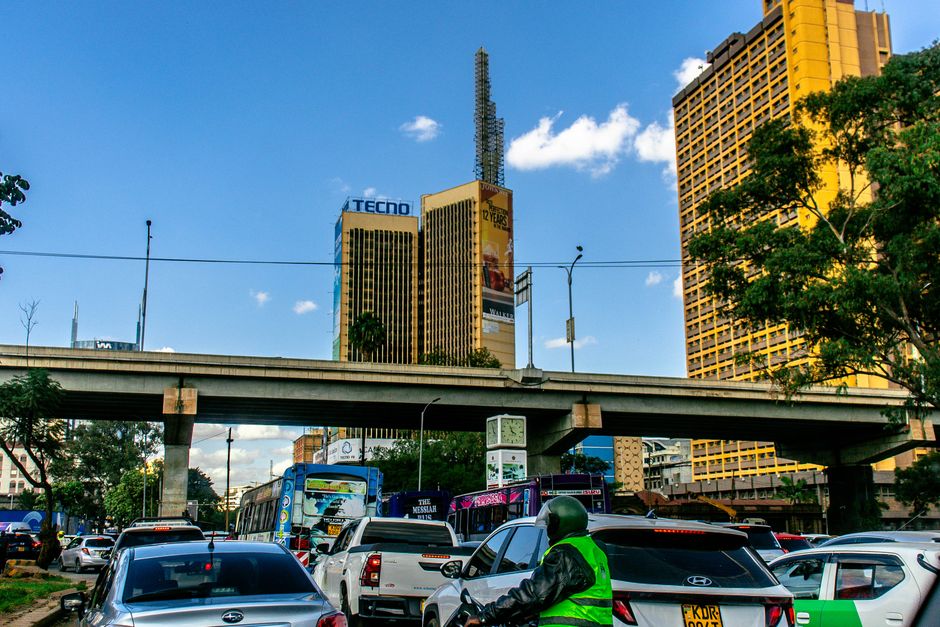
Nairobi commuters collectively wasted an estimated 73 million productive hours sitting in traffic in 2025, according to figures compiled by the Kenya National Highways Authority and cross-referenced with traffic analytics from Nairobi Metropolitan Services. That works out to roughly 8,300 years of human time, gone, in a single calendar year. And the numbers for the first half of 2026 suggest this year will be worse.
The timing matters. The Ruto administration is midway through an IMF-backed fiscal consolidation programme that has squeezed infrastructure budgets and delayed contractor payments on at least three major transport projects. Every hour a Westlands accountant or a Mathare factory worker spends on Waiyaki Way or Jogoo Road is an hour subtracted from economic output the government is desperately trying to grow. The World Bank estimated in its 2024 Kenya Infrastructure Review that Nairobi's congestion costs the economy between Ksh 50 billion and Ksh 60 billion annually in lost productivity — a figure that has not improved.
The Expressway Numbers Do Not Lie — But They Require Context
The Nairobi Expressway, the 27.1-kilometre elevated toll road stretching from Mlolongo in the east to Westlands in the west, was supposed to drain traffic off the congested Uhuru Highway corridor. Eighteen months after full operationalisation, average daily vehicle counts on the expressway plateaued at around 28,000 trips per day in the first quarter of 2026, well below the 60,000-trips-per-day threshold that the project's feasibility study projected for this period. The primary reason cited in an internal report by the Kenya National Highways Authority dated March 2026: toll costs. A one-way trip from the Mlolongo entry to the Westlands exit costs Ksh 455 for a saloon car. For a matatu driver running two round trips daily, that is Ksh 1,820 subtracted from margins already compressed by fuel prices sitting above Ksh 210 per litre. Most matatus simply refuse to use it, clogging the old ground-level highway below instead.
Meanwhile, on Ngong Road, the Bus Rapid Transit corridor that the Nairobi Metropolitan Services has been constructing in phases since 2022 remains incomplete at the Dagoretti Corner junction, one of the city's most notorious chokepoints. Construction progress stalled for approximately four months between November 2025 and February 2026 after a payment dispute with a Chinese contractor, Sinohydro, over a Ksh 2.3 billion outstanding invoice. Works resumed in March, but the dedicated BRT lane between Dagoretti Corner and the CBD is not expected to open before the fourth quarter of 2026, according to the project's revised schedule published by Nairobi Metropolitan Services in May.
What the Commuter Rail Data Shows
There is one relative bright spot. Ridership on the Nairobi Commuter Rail network operated by Kenya Railways climbed to 65,000 daily passengers in June 2026, up from 41,000 in June 2024. The Syokimau line, connecting the eastern suburbs to the Central Railway Station on Haile Selassie Avenue, accounts for roughly 40 percent of that traffic. A flat fare of Ksh 100 from Syokimau to town, compared with Ksh 150 to Ksh 200 on matatus for the same route, is clearly driving the shift. The problem is capacity: trains on the Syokimau corridor run at over 120 percent occupancy during the 7 a.m. to 9 a.m. peak window, and Kenya Railways has only four serviceable diesel multiple unit sets available for the entire network.
For commuters making practical decisions right now, the data points toward rail where available and departing before 6:30 a.m. or after 9:00 a.m. to avoid the worst of the ground-level congestion. For policymakers, the harder arithmetic involves the BRT timeline: each month of delay on the Ngong Road corridor costs an estimated Ksh 4.1 billion in aggregate lost productivity, according to modelling by Strathmore University's Centre for Sustainable Cities, published in April 2026. That figure exceeds the disputed Sinohydro invoice by nearly double. The contractor has been paid. The delay has not been recovered.